Periodontal Care: Choosing a Specialist in the Dallas Area
A practical guide to picking a board-certified periodontist in the DFW area — what credentials and equipment to look for, and when to skip the general dentist for the specialist.
By Dr. Vic Gandhi
When your general dentist tells you, "I'd like you to see a periodontist," the next question is usually: which one, and what makes one different from another? Dallas has plenty of dental offices that advertise gum disease treatment. Far fewer are run by board-certified periodontists. Here is how to tell them apart, and what to look for in the practice you choose.
What a periodontist actually is
A periodontist is a dentist who completed three additional years of training in gum disease, bone grafting, and dental implant surgery after dental school. The American Board of Periodontology then tests that training. Board certification is the credential that matters.
In the Dallas-Fort Worth area, a few hundred dentists call themselves periodontists. About a third are board-certified. Both Dr. Vic Gandhi and Dr. Trey Gandhi at our offices are board-certified, which means they've been tested on the work, not only that they've taken the training.
When to see a periodontist, not a general dentist
Most general dentists handle routine cleanings and early-stage gum inflammation. You should see a periodontist when:
- Your gums bleed every time you brush, or pull away from your teeth
- Your dentist mentions "pockets" deeper than 4mm
- You've been told you need a deep cleaning or scaling and root planing
- You have a tooth that needs to come out and you are considering an implant
- You have an implant that is loose or showing signs of failure
- You've been told your gums are recessing
A periodontist treats the bone and gum that surround the teeth. A general dentist treats the teeth themselves. The two roles overlap, but for advanced cases the specialist has the right training and the right tools.
What to look for in a Dallas-area periodontist
Board certification. Ask. Look at the diplomas on the wall. If the office isn't sure, that's an answer in itself.
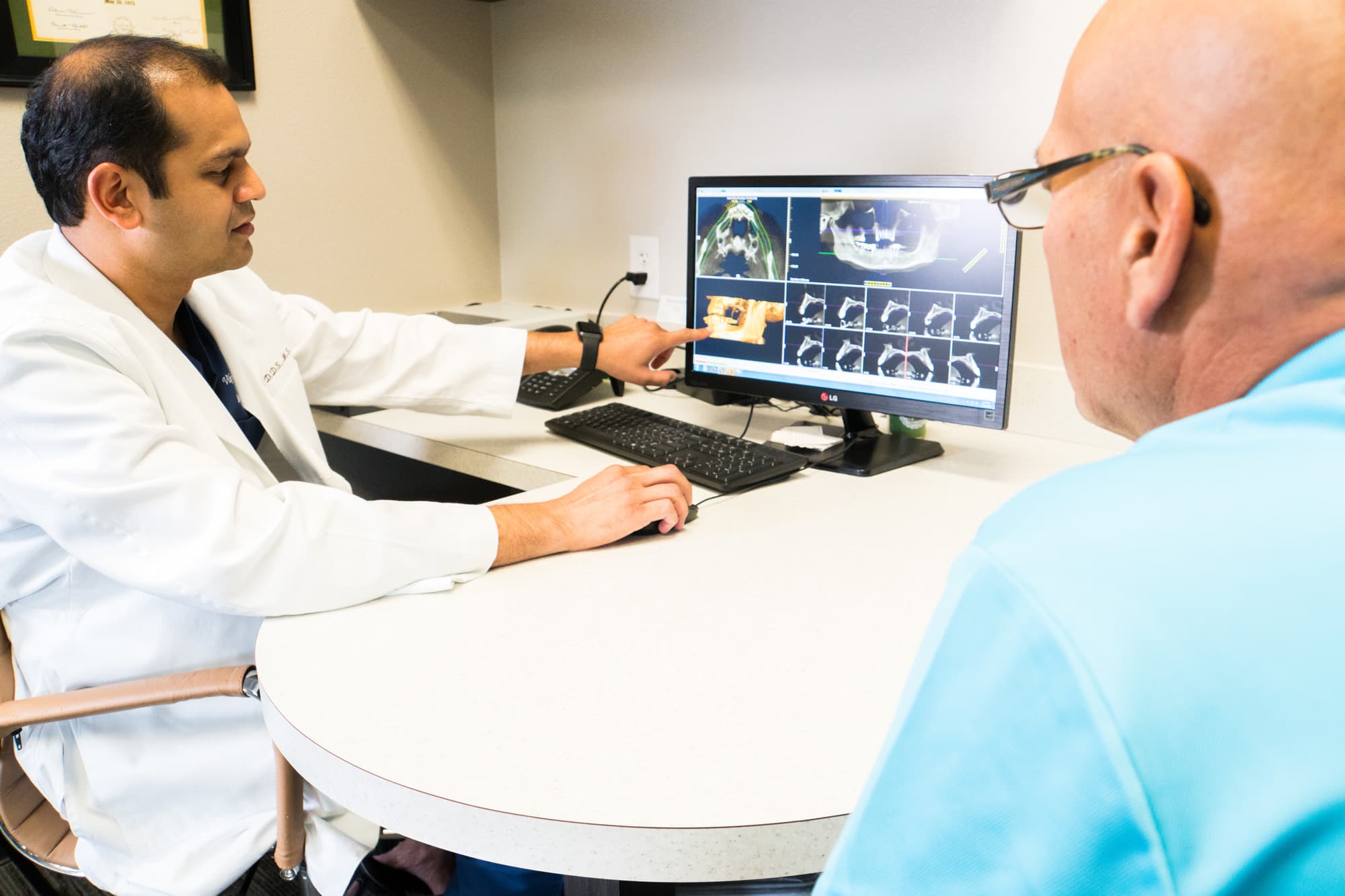
A 3D CBCT scanner in-house. A CBCT scan shows your bone, your nerves, and your sinuses in three dimensions. It is the difference between a guess and a plan. Any periodontist doing implants without one is working with incomplete information.
Clear pricing. A good office tells you the cost before the work, in writing, and explains why. A vague answer at the consultation tends to turn into a surprise bill later.
Sedation options. For most periodontal procedures, local anesthesia is enough. For longer cases or patients who have a hard time with dental work, IV sedation should be available with a trained team. We provide both.
Continuing care that doesn't disappear. Periodontal treatment is most successful when the office plans follow-up cleanings and tracks bone levels over time. Ask what the long-term plan looks like, not only the initial procedure.
What treatment usually looks like
For early gum disease, treatment is non-surgical. We clean under the gum line, smooth the root surfaces, and address the underlying causes: bite, hygiene habits, diet, sometimes a medication that is drying out the mouth.
For moderate to advanced gum disease, we may use LANAP laser therapy. The LANAP laser removes diseased tissue without cutting and stitching, and recovery is shorter than traditional gum surgery. We were one of the first offices in the Dallas area to bring LANAP in-house.
For cases where gum or bone has already been lost, we rebuild it. Gum grafting covers exposed roots. Bone grafting prepares the jaw for an implant or stabilizes a tooth.
How patients usually find the right fit
Most patients we see are referred by their general dentist. That is the simplest path, because your general dentist already knows your history. If you don't have a dentist or you want a second opinion, you can come directly. We coordinate with your general dentist on a treatment plan that fits the rest of your dental care.
We see patients from all over the Dallas area, including Garland, Plano, Mesquite, Richardson, Rowlett, and Wylie, at our Firewheel office on Beebalm Lane. We see patients from Greenville, Commerce, and Sulphur Springs at our Traders Road location. Pick whichever is closer.
Schedule a consultation
If you've been told you need gum disease treatment, an implant, or a graft, schedule a consultation at either office. Bring any X-rays you have. We review them, scan if we need a clearer picture, and walk through your options before recommending anything.